We are re-publishing articles from our archives, this one written by former ORA President, Dale E. Schuster. This is from the July 2015 Issue of the Sharpshooter.
Some of you will no doubt recognize this excerpt from the 23rd Psalm, but today I’d like to bring this into modern times, if at all possible.
Even though I must travel the most dangerous streets of our cities, I am not afraid, Lord, for you are with me, Your rod and Your staff will protect me.
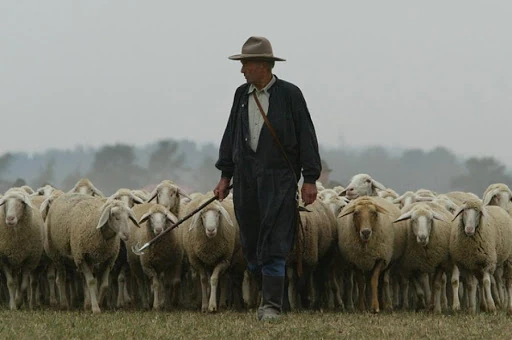
Let’s look at this for a minute. What are a “rod and staff?” Obviously they are weapons. The dictionary states that a staff is “a stick or club carried for support or combat.” The “shepherd’s staff” usually had a crook in one end of it for capturing sheep.
Why am I getting into Biblical terms and Scripture? Some years ago I was confronted by a supposedly religious individual who commented to a group of listeners how I could call myself a Christian when I possessed and was fascinated by “evil weapons of death (firearms).” At that time I knew enough about Scriptrure to extricate myself and shortly, turned the tables on my tormentor leaving him, so to speak, “hooked on the staff.”
Since that time I have been curious about the weapons of Biblical times and the answer to one question my tormentor asked repeatedly: “Would Jesus have carried a firearm?” In Bilblical times the answer would be, “His power was such that he didn’t need a weapon.”
I wondered would Jesus have approved or disapproved of someone else carrying one for self-defense in modern times?
The idea that Jesus was a pacifist seems to be the doctrine of the politically correct. But Jesus was not a pacifist. He didn’t go looking for trouble, but he didn’t run when it came looking for him either. Sometimes he could turn away trouble with a word or two. “Let he who is without sin amoung you first cast a stone”… John 8:7. Other times he had to employ something more physical, such as throwing the money changers out of the temple in Luke 19:45 saying, “My house is the house of prayer: but ye have made it a den of thieves.”
There are many places in the Bible where the Israelites are commanded to take up weapons against opposing armies and defeat them in the name of God. Joshua fought the ballte of Jerico using “horns” and a lot of help from above!
The passage that explains self-defense to me est takes place in Luke Chapter 22. It goes like this: after hte last supper, Jesus was speaking to his disciples of the times to come, “And He said, ‘When I sent you without purse, and scip, and shoes, lacked ye any thing?’ And they said, ‘nothing.’ Then He said unto them, ‘but no w let he that hath a purse, let him take it, and likewise his scrip and he that hath no sword, let him sell his garment and buy one. For I say unto you, that this that is written must be accomplished bin me. And he was reckoned among the transgressors: of the things concerning me have an end.’ And they said, ‘Lord, behold, here are two swords.’ and He said unto them, ‘It is enough.'”
Here, Jesus is clearly telling his disciples that he will no longer be able to protect them and they will no need to supply their own self-defense. He tells them to “sell your garment” to buy a sword. According to some Biblical schols I spoke to about this passage, one of the translations was “sell your cloak.” The “cloak” was a very important garment in Biblical times. It was large, usually six feet wide, made of two three-foot-wide pieces of cloth (most of the looms of the time were only three feet wide). Jesus’ lcoak was an exception, being six feet of solid cloth, it was probably woven on the looms of a rich individual and given to him as a gift.
The cloak was made of wool which would retain heat when wet and, having a natural lanolin from the sheep, was somewhat water repellent. The cloak was important when traveling because there were no roadside motels and very few inns along the way. Travelers could stay in the local “inn” if they had the money to do so, but many did not. It was also possible to spend the night in a manger with liestock. Sometimes, homeowners would let you sleep on the top of their houses if you asked, could but safe from wild animals (lions, asps, etc.). Many times the weary traveler just slept on the ground or along the road using his clok for, you got it, a sleeping bag. That’s what I call really “roughing it.”
So, to say “sell your cloak and buy a sword” meant giving up a very important piece of your traveling equipment for your self-defense equipment.
Here it must be noted that one minister I spoke to did come up with another answer to the Luke 22 passage. he called it a “difficult passage” and said it was spoken in “hyperbole.” He said Jesus and his disciples were discussing the main problem they were having was opposition from the high priests and the Roman government (sound familiar?) who did not have much use fo rthe Christian religion.
The disciples had considered the possibility of physically resisting the priests and Romans. Jesus listening to the discussion mad the statement, sell your cloaks and buy swords to fight the Romans, as an attempt to show his disciples the futility of their idea. Sort of like saying if you don’t like the U.S. government, sell your house and most of what you own, buy a gun and fight the government.
Here I must say, this minister does support the idea of firearms ownership for self-defense. Please don’t get the idea that he is anti-gun. He is not. This gentleman said tha tthe disciples did, on occasion, carry swords for self-defense when they traveled.
He just gave me a different interpretation of the passage. A very interesting one, too, I might add. The good Revered also said the way to remove evil men from the government was to elect good Christian ment to replace them. Mos tof us would agree. (I wish we could have done that in the last election!) Still, there are other teaching in the Bible that support self-defense, but time and space do not permit me to go into all of them here.
I sitll take the passage in Luke literally and I believe if someone had been carrying a firearm in a church in Charleston, NC, not long ago, the outcome would have been much different. In a past similar incident the Texas legislature prohibited concealed-carry in churches (the government again) and it is easy for criminals to find unarmed victims in Texas. Just read the law… criminals don’t read the law. Trust me, they know it better than you think.
How about you? What do you think… would Jesus believe in carrying a firearm, concealed, for self-defense today?
I will close wiht something that happened to me about 20 years ago at my church. a Dr. Hugh Morton from Norman, Oklahoma, was our minister for a few months.
Now, Dr. Morton was descended from a Scottish father and a Chinese mother. While short in stature and bald, he had a barreled chest and a booming baritone voice… with a slight Scottish brogue. Perfect for a minster, in my opinion. Trust me, you did not sleep through his sermons! Upon leaving church one Sunday morning, I stopped to shake hands with Dr. Morton. His eyes spotted the NRA life membership pin on my lapel. He adjusted his bifocals, examined the pin, and said in his best brogue, “Very good, my son. A man needs a firearm these days with all this devilment about!”
I thanked him for his kind words and when I got to the car I laughed so hard I thought my wife was going to have to drive home. Although huorous, Dr. Morton’s words were as true then as they are today. Thank you, Dr. Morton, and God bless you wherever you are.
My sincere thanks to the Biblical scholars who helped me with this article. They are: Mrs. Cindy Hempkin, Mrs. Linda Poetter, ORA Life Member Harvey Poetter, ORA, ORA member Marcus Harris, and his friend, the Revered Melvin Lovings. Without their splendid assistance, this article would not have been possible.